MEHRANGARH FORT JODHPUR: The Mighty Fortress of the Blue City — A Complete Travel & Heritage Guide
By Jitendra Singh 10 Apr 2026 16 min read
Introduction: The Fortress That Commands the Horizon
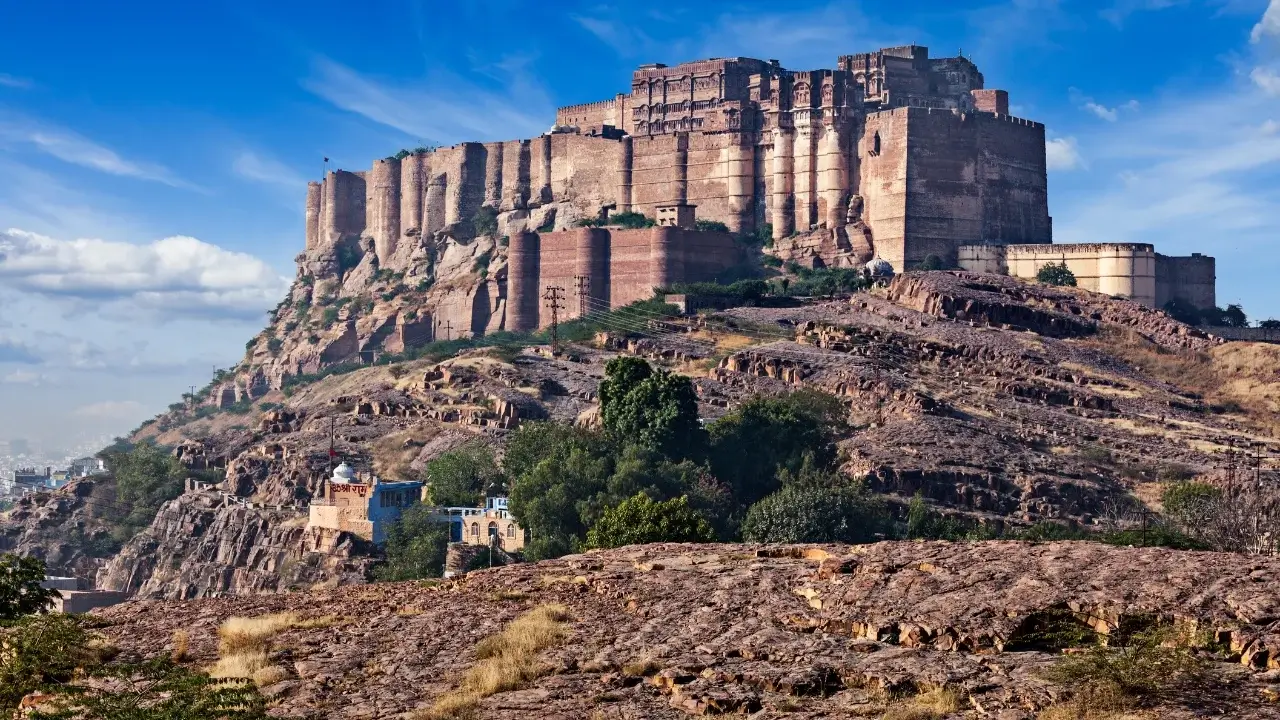
Rising 410 feet above the sun-scorched plains of Jodhpur, Mehrangarh Fort stands as one of the most awe-inspiring fortresses in all of India — and arguably the world. Its colossal ramparts, stretching over 10 kilometres, enfold palaces of breathtaking artistic grandeur, a world-class museum, and centuries of Rajput glory. From its towering bastions, the city of Jodhpur fans out in a brilliant cascade of blue-painted houses — earning this ancient city its beloved nickname: the Blue City.
For travellers seeking the soul of Rajasthan, Mehrangarh is not merely a stop on the itinerary — it is the destination. Whether you arrive as part of bespoke luxury Rajasthan tour packages, an immersive heritage tour Rajasthan journey, or a tailor-made 14 days Rajasthan tour package, an audience with Mehrangarh is non-negotiable. This guide covers everything you need to know about this extraordinary monument: its history, architecture, museums, festivals, photography spots, practical tips, and more.
Quick Facts at a Glance
| Fort Name | Mehrangarh Fort |
| Location | Jodhpur, Rajasthan, India |
| Built | 1459 AD |
| Founded by | Rao Jodha (Rathore Clan) |
| Elevation | 410 feet (125 metres) above the city |
| Area | Approx. 1,200 acres |
| Entry Fee (Indian) | 100 (Adults), 50 (Children) |
| Entry Fee (Foreign) | 600 (Adults), 300 (Children) |
| Timings | 9:00 AM – 5:00 PM (All days) |
| Camera Fee | 100 (Still), 200 (Video) |
History of Mehrangarh Fort
Origins and Foundation (1459 AD)
The story of Mehrangarh begins in 1459 AD when Rao Jodha, the fifteenth chief of the Rathore clan, decided to shift his capital from the crumbling Mandore fortress to a more commanding location. He chose a massive rocky outcrop called Bhakurcheeria — 'the Mountain of Birds' — rising from the Thar Desert plains, and began construction of a fort that would match the ambitions of his dynasty.
Legend entwines itself around the fort's founding. According to local tradition, a hermit named Cheeria Nathji, who meditated on the hill, was displaced to allow construction to begin. He reportedly cursed the fort to suffer perpetual water scarcity. Rao Jodha, seeking to appease him, buried a man named Rajiyaram Meghwal alive within the fort's walls as a sacrifice. The Meghwal family is said to have been compensated for generations — a practice that continued until very recently.
Growth Through the Rathore Dynasty
Mehrangarh was not built in a single reign — it is the cumulative creation of many Rathore rulers, each adding palaces, bastions, and temples over five and a half centuries. Rao Maldeo (1532–1562), one of Jodhpur's most powerful rulers, greatly expanded the fortifications. He turned the fort into an almost impregnable military stronghold during a period of intense Rajput power.
Maharaja Jaswant Singh I (1638–1678) added the magnificent Moti Mahal (Pearl Palace) and several other palatial structures. The fort's role evolved from a purely military garrison to a seat of regal culture, refined taste, and artistic excellence. The Mughal influence — owing to diplomatic and matrimonial alliances — introduced Persian architectural elements that blended harmoniously with indigenous Rajput style.
Maharaja Ajit Singh (1678–1724) built the exquisite Phool Mahal (Flower Palace), considered one of the most ornate durbar halls in Rajputana. Each successive ruler left his artistic signature on the fort, making it a layered testament to centuries of royal patronage.
The Fort Under Maharaja Man Singh
Maharaja Man Singh (1803–1843) was responsible for the final and most elaborate phase of construction. Under his rule, intricate latticed windows (jharokhas), ornately carved archways, and the famous Sheesh Mahal (Mirror Palace) were added. The fort reached its current splendid form largely through his vision. Man Singh was also a renowned musician and poet, and his cultural patronage is reflected in every carved surface of the palace interiors.
Post-Independence Era
After Indian independence in 1947, Maharaja Hanwant Singh and later Maharaja Gaj Singh II worked to preserve and open Mehrangarh to the public. In 1972, the Mehrangarh Museum Trust was established, transforming portions of the fort into one of India's finest palace museums. Today, it attracts over one million visitors annually and is widely considered a benchmark of heritage preservation in Rajasthan — and indeed in all of Asia.
Architecture: A Marvel in Golden Sandstone
Mehrangarh is constructed primarily from the honey-gold Jodhpuri sandstone that glows amber at sunrise and deep ochre at sunset. The fort's architecture is a rare and harmonious synthesis of Rajput military genius and Mughal ornamental sensibility, resulting in a monument that is simultaneously formidable and beautiful.
The Ramparts and Gates
The fort's outer walls are between 20 to 36 metres thick in places — a staggering width designed to withstand cannon fire. Seven imposing gates (pols) guard the winding approach to the summit, each built to present tactical obstacles to any army attempting to storm the fort. These gates are:
- Jai Pol (Victory Gate) — Built by Maharaja Man Singh to celebrate victories over Jaipur and Bikaner armies.
- Fateh Pol (Triumph Gate) — Commemorates Maharaja Ajit Singh's victory over the Mughals.
- Gopal Pol — A notable ceremonial gate with intricate carvings.
- Bhairon Pol — Named after the deity Bhairon, whose shrine guards the gate.
- Dedh Kamgra Pol — Features two cannon balls embedded in its wall from the 1808 siege of Jodhpur.
- Amrit Pol (Gate of Immortality)
- Loha Pol (Iron Gate) — The final gate before the main palace complex, featuring the deeply moving sati handprints of royal widows.
The Sati Handprints
Just inside Loha Pol, embedded in the warm sandstone, are the handprints of the royal widows who committed sati — the practice of self-immolation on a husband's funeral pyre — upon the death of Maharaja Man Singh in 1843. These 15 handprints, some belonging to queens and others to concubines, remain one of the most haunting and deeply affecting sights in all of Rajasthan. They serve as a stark reminder of a practice now outlawed and condemned, yet they are deeply venerated by many locals.
The Palaces Within
Once past the gates, the fort reveals an unexpected interior world of dazzling palaces. The contrast between the brutal military exterior and the refined elegance within is one of Mehrangarh's most striking characteristics.
- Moti Mahal (Pearl Palace) — The grandest durbar hall of the fort, featuring five hidden galleries from which the royal ladies could observe court proceedings without being seen. The ceiling is encrusted with mirror glass and stucco ornament.
- Phool Mahal (Flower Palace) — The most ornate of all the palaces, used as a pleasure pavilion. The ceiling is gilded with gold sourced from war spoils and merchant taxes. Exquisite miniature paintings line the walls.
- Sheesh Mahal (Mirror Palace) — Its walls and ceilings are encrusted with thousands of tiny convex mirrors, creating a magical, crystalline effect when a single candle is lit within.
- Takht Vilas — The personal chamber of Maharaja Takht Singh (1843–1873), featuring walls covered in Victorian Christmas ornaments embedded in plaster — a quirky blend of East and West.
- Jhanki Mahal — The palace of the royal ladies (zenana), featuring beautiful latticed screens (jalis) through which women could observe public life while remaining unseen.
- Daulat Khana — A treasury and armoury that now houses palanquins, howdahs, and elephant thrones.
Mehrangarh Museum: Rajasthan's Finest Palace Museum
The Mehrangarh Museum Trust, established in 1972 under the patronage of Maharaja Gaj Singh II, has transformed Mehrangarh into one of India's finest and most thoughtfully curated palace museums. The museum spans multiple palaces and galleries, housing one of the richest royal collections in Rajasthan.
Gallery Highlights
- Armour Gallery (Sileh Khana): An extraordinary collection of royal weaponry — swords, shields, daggers, elephant armour, and personal arms of the Rathore kings. The elephant armour (Hathi Ka Kawach) is particularly rare and remarkable.
- Palanquin Gallery: A stunning display of royal palanquins and howdahs (elephant saddle-thrones) used by the maharajas and their queens.
- Miniature Painting Gallery: An exquisite collection of Marwar School miniature paintings depicting court scenes, mythology, music, and wildlife.
- Textile & Costume Gallery: Royal robes, turbans, and jewelled accessories that illuminate the sartorial splendour of the Rathore court.
- Cradle Gallery: An unusual and intimate collection of royal cradles, offering a poignant window into royal domesticity.
- Nagnechi Mata Temple: An ancient temple to the kuldevi (clan goddess) of the Rathore clan, located within the fort complex.
Best Time of Day
Early morning (just after 9 AM opening) is ideal — the light is soft, the crowds are thin, and the air is crisp. The fort at sunset is equally spectacular, as the golden sandstone catches the slanting light. Midday in summer can be extremely hot; carry water and wear sun protection.
Festivals & Events at Mehrangarh
World Sacred Spirit Festival
Held annually in February, this internationally acclaimed music festival brings Sufi mystics, folk musicians, and world music artists from across the globe to perform on the ramparts of Mehrangarh. Under a canopy of stars, with the blue city shimmering below, it is one of the most magical concert experiences in the world. Travellers on luxury Rajasthan tour packages often time their visit to coincide with this extraordinary event.
Rajasthan International Folk Festival (RIFF)
RIFF, held in October around the full moon of Sharad Purnima, is a celebration of Rajasthani and world folk music. It takes place across Mehrangarh and the city of Jodhpur, with candlelit performances on the fort's bastions and terraces.
Navratri at Chamunda Mata Temple
The Chamunda Mata Temple within the fort is one of Jodhpur's most sacred shrines. During the nine nights of Navratri (September-October), it is illuminated and thronged with devotees. The atmosphere is electric with devotional fervour.
Things To Do at Mehrangarh Fort
- Explore the seven gates and their carved inscriptions
- Walk the ramparts for 360-degree panoramic views of Jodhpur
- Spend time in each palace gallery of the museum
- Listen to the audio guide narrated by Peter Ustinov
- Have lunch or tea at the Chokelao Garden Restaurant, a beautifully restored garden-restaurant within the fort
- Zip-line over the fort walls with Flying Fox — one of India's most dramatic zip-line experiences
- Visit the Chamunda Mata Temple for blessings
- Browse the heritage craft shops within the fort premises
- Catch a sunrise or sunset from the ramparts
- Attend a live folk music performance (check the event calendar)
How to Reach Mehrangarh Fort
- By Air: Jodhpur Airport (JDH) is approximately 5 km from the fort. Taxis and auto-rickshaws are readily available.
- By Train: Jodhpur Railway Station is the main railhead, approximately 3 km from the fort. The station is well connected to Delhi, Mumbai, Jaipur, and Udaipur.
- By Road: Jodhpur is excellently connected to all major Rajasthan cities. NH 62 connects it to Jaipur (335 km), Udaipur (250 km), and Bikaner (250 km). Most 14 days Rajasthan tour packages pass through Jodhpur as a key destination.
Best Time to Visit Mehrangarh
October to March is the ideal season to visit Mehrangarh and Jodhpur. The weather is pleasant, the skies are clear, and the fort glows magnificently in winter light. April to June is extremely hot (temperatures may exceed 45°C in the fort) and is best avoided unless you visit very early in the morning. July to September (monsoon) brings dramatic cloud formations above the fort, which can make for spectacular photography, though the heat remains.
What to Wear
Mehrangarh involves extensive walking on uneven stone surfaces and steep ramps. Comfortable, closed-toe footwear is essential. Dress modestly out of respect — avoid shorts and sleeveless tops. A hat, sunglasses, and sunscreen are strongly advised. Carry at least 1–2 litres of water, especially in warmer months.
Nearby Attractions: Beyond the Fort
Jodhpur has much to offer beyond Mehrangarh. Plan to spend at least 2 full days in the city to do it justice, as is typically included in well-crafted Rajasthan tour packages.
- Jaswant Thada (1 km) — A stunning white marble cenotaph built in 1899 in memory of Maharaja Jaswant Singh II. Often called the 'Taj Mahal of Marwar'.
- Umaid Bhawan Palace (5 km) — A magnificent art deco palace, part of which is managed as a luxury Taj hotel. One of the world's largest private residences. An unmissable feature of luxury Rajasthan tour packages.
- Ghanta Ghar (Clock Tower) Market — The vibrant old city market beneath the fort, perfect for spices, textiles, silver jewellery, and local snacks.
- Mandore Gardens (8 km) — The ancient capital of the Rathores, featuring ruined temples and royal cenotaphs.
- Balsamand Lake (5 km) — A tranquil 12th-century artificial lake and garden.
Mehrangarh in the Context of Rajasthan Tour Packages
Jodhpur and Mehrangarh Fort occupy a central role in virtually every well-designed Rajasthan tour package. The city sits at the geographic and cultural heart of the Thar Desert region, making it a natural hub for travellers exploring the Golden Triangle of Rajasthan or the grand circuit of the state's royal cities.
Where Jodhpur Fits in Rajasthan Itineraries
- Classic Rajasthan Tour Packages typically follow the route: Jaipur → Pushkar → Jodhpur → Jaisalmer → Bikaner → back.
- Heritage Tour Rajasthan itineraries focus on the fort circuit: Amber Fort (Jaipur) → Mehrangarh (Jodhpur) → Junagarh Fort (Bikaner) → Jaisalmer Fort — a sequence that showcases Rajputana military architecture across different eras.
- Luxury Rajasthan Tour Packages combine Mehrangarh with a stay at Umaid Bhawan Palace (Jodhpur), the Taj Lake Palace (Udaipur), and Rambagh Palace (Jaipur) — an experience of unparalleled royal grandeur.
- 14 Days Rajasthan Tour Packages typically allocate 2 full days to Jodhpur, allowing thorough exploration of Mehrangarh, Umaid Bhawan, Jaswant Thada, and the old city bazaars.
Travel Tip: If you're planning a 14 days Rajasthan tour package, allocate at least 2 full days to Jodhpur. Mehrangarh alone deserves a full morning — the museum, palaces, galleries, ramparts, and the audio guide together take 3–5 hours. Combine with Umaid Bhawan Palace and Jaswant Thada in the afternoon.
Frequently Asked Questions (FAQs)
Q: What is the entry fee for Mehrangarh Fort in 2026, and what does it include?
A: As of 2026, Indian visitors pay ?100 for adults and ?50 for children (below 12). Foreign visitors pay ?600 for adults and ?300 for children. The ticket includes access to all the palace galleries and the museum. Students with valid ID cards receive concessions. The audio guide (narrated by the late Sir Peter Ustinov, in multiple languages) is included in foreign visitor tickets and is available for a small extra charge for Indian visitors. Camera and video permissions require an additional fee (?100 for still cameras, ?200 for video cameras). Flying Fox zip-lining is a separate, ticketed experience.
Q: What is the best time of year to visit Mehrangarh Fort, Jodhpur?
A: The best time to visit Mehrangarh Fort is from October to March. During these months, the weather in Jodhpur is pleasantly cool and dry, with daytime temperatures ranging from 15°C to 28°C — ideal for extensive walking and outdoor exploration. December and January are particularly popular months. The fort is especially magical around the Rajasthan International Folk Festival (RIFF) in October/November, when live performances take place on the ramparts under a full moon. The World Sacred Spirit Festival in February is another excellent time to visit. Avoid April to June if you are sensitive to heat, as temperatures inside the fort can exceed 45°C.
Q: How long does it take to fully explore Mehrangarh Fort?
A: A thorough visit to Mehrangarh Fort — covering all seven gates, the main palace galleries (Moti Mahal, Phool Mahal, Sheesh Mahal, Takht Vilas, Jhanki Mahal), the museum, the armour gallery, the rampart walk, the Chamunda Mata Temple, and the audio guide — takes approximately 3 to 5 hours. If you wish to also enjoy lunch at the Chokelao Garden Restaurant, do the Flying Fox zip-line, and browse the in-fort craft shops, budget a full day. For travellers on a 14 days Rajasthan tour package or a heritage tour of Rajasthan, a half-day for the fort (morning) and a half-day for the rest of Jodhpur's attractions is a practical division.
Q: Is Mehrangarh Fort accessible for senior citizens and visitors with mobility challenges?
A: Mehrangarh Fort is a historic monument built on a steep hill, and significant portions involve steep inclines, uneven stone surfaces, and steps. However, the Mehrangarh Museum Trust has made commendable accessibility improvements in recent years. A battery-powered vehicle (buggy) is available to carry visitors with mobility challenges from the main gate up to the palace level. Inside the palace complex, most of the key galleries are accessible via ramps. Wheelchairs are available on request. It is advisable to contact the Mehrangarh Museum Trust in advance if you require specific assistance, particularly if you are planning a luxury Rajasthan tour package for senior travellers, so that arrangements can be made ahead of arrival.
Q: Can Mehrangarh Fort be visited as a day trip from Jaipur or Udaipur?
A: Mehrangarh Fort is located in Jodhpur, which is approximately 335 km from Jaipur (5–6 hours by road or 4–5 hours by train) and about 250 km from Udaipur (4–5 hours by road). While technically possible as a day trip, it is strongly advised against — the journey is long, and a day trip would leave you with barely 2–3 hours at the fort, which is wholly insufficient. We strongly recommend staying at least 2 nights in Jodhpur to do full justice to Mehrangarh, Umaid Bhawan Palace, Jaswant Thada, and the old city market. This is precisely why all well-designed Rajasthan tour packages and heritage tour Rajasthan itineraries include at least 2 nights in Jodhpur.
Conclusion: Why Mehrangarh Must Be on Your Rajasthan Itinerary
Mehrangarh Fort is not just a monument — it is an experience, a living chapter of Rajasthan's glorious history carved in golden stone. From the thundering bulk of its fortifications to the whispering delicacy of its latticed windows; from the haunting handprints of the sati queens to the gilded ceilings of Phool Mahal — every moment spent within Mehrangarh is a moment in the company of history.
Whether you are embarking on your first visit to Rajasthan or returning as a seasoned explorer, whether you travel on budget Rajasthan tour packages or the most exclusive luxury Rajasthan tour packages, Mehrangarh Fort demands your time, your reverence, and your camera. It is a monument that has inspired awe in travellers for five and a half centuries — and it will do the same for you.
Book your Rajasthan tour packages today and let Mehrangarh Fort be the crown jewel of your Rajasthan sojourn. Whether it is a curated heritage tour Rajasthan experience, an indulgent luxury Rajasthan tour package, or a comprehensive 14 days Rajasthan tour package — the Mighty Fortress of the Blue City awaits you.
Jitendra Singh - Maharaja Trails
Maharaja Trails travel experts share authentic travel guides, itineraries and insider tips for exploring India including Delhi, Agra, Jaipur and the Golden Triangle. Our goal is to help travellers experience India's culture, history and heritage in the best possible way.
0 Comments
Leave a Reply
Your email address will not be published. Required fields are marked *